Healthy Holiday Eating Tips: Enjoy the Food Without Losing Your Routine
Originally published · Updated
Healthy holiday eating is not about avoiding pie, stuffing, cocktails, or family recipes. It is about keeping enough structure around the celebration meals that a few special occasions do not turn into six weeks of unplanned eating.
The most practical strategy is simple: keep your normal meals reasonably consistent, prioritize protein and fiber-rich foods most of the time, choose the holiday foods you actually care about, be intentional with alcohol, stay active, and return to your normal routine at the next meal—not next Monday or January 1.
Forge Verdict
You do not need a perfect holiday diet. You need a repeatable one. Maintain your usual eating structure on ordinary days, enjoy celebration foods deliberately rather than grazing automatically, and avoid the restrict-overeat-punish cycle. A holiday meal is not a problem. Losing your routine for an entire season is.
Keep Your Structure
Regular meals, adequate protein, produce, fiber, and hydration make it easier to arrive at gatherings hungry—not ravenous.
Choose What Matters
Holiday foods can absolutely fit. Spend your appetite on the traditions and treats you genuinely enjoy instead of eating everything because it is available.
Resume Immediately
One large meal does not require fasting, punishment workouts, or a detox. Your next meal can simply look normal again.
How Much Weight Do People Actually Gain During the Holidays?
The familiar claim that the average person gains five to ten pounds between Thanksgiving and New Year’s is not supported by good evidence. In a classic prospective study of 195 adults, average weight gain across the six-week holiday period was about 0.37 kg—roughly 0.8 pounds. Reviews of holiday-weight research have generally found average gains closer to about half a kilogram than five pounds, although individual changes vary widely.
That does not mean holiday habits are irrelevant. Some people gain considerably more than average, and small seasonal gains can matter if they are repeated year after year and never fully lost. The useful takeaway is not panic. It is perspective.
A heavier scale reading after a holiday meal is not automatically body-fat gain
Large meals often contain more carbohydrate, sodium, restaurant food, desserts, and alcohol than usual. That can temporarily increase food mass and body water. Judge the season by trends over time—not by the morning after Thanksgiving dinner.
Your Holiday Goal Does Not Have to Be Weight Loss
For someone actively trying to lose body fat, the holidays can be a reasonable time to temporarily shift from aggressive progress to maintenance or slower progress. That is not failure. It can be a deliberate strategy that protects habits while allowing room for travel, family traditions, work parties, and social meals.
A holiday-season goal might be:
- Maintain your normal breakfast and lunch most days.
- Strength train or exercise on a realistic schedule.
- Keep protein and fiber-rich foods consistent.
- Enjoy planned holiday meals without turning every day into a holiday meal.
- Maintain body weight within a reasonable personal range rather than chasing rapid loss.
Research supports the broader idea that simple self-regulation strategies can matter. In a randomized Christmas-period trial, a brief behavioral intervention built around regular self-weighing and practical weight-management guidance helped prevent holiday weight gain compared with general healthy-living information.
Do Not Starve Yourself Before the Party
One of the most common holiday strategies is to “save calories” by barely eating all day before a large dinner. On paper, that can reduce earlier calorie intake. In practice, arriving extremely hungry can make it much harder to eat deliberately once appetizers, alcohol, desserts, and family favorites are everywhere.
A more useful approach is to keep earlier meals lighter if appropriate, but still structured. Include protein, produce, and enough food to maintain reasonable hunger and energy.
Breakfast
Eggs with fruit, Greek yogurt with berries, or another protein-centered meal you normally tolerate well.
Lunch
Lean protein with vegetables, soup and a sandwich, a grain bowl, or a similar balanced meal—not an intentional fast unless fasting is already part of an appropriate routine for you.
Before the Event
If dinner is late, a small protein- and fiber-containing snack can be more useful than arriving after seven hours without food.
How to Build a Holiday Plate Without Turning Dinner Into Math
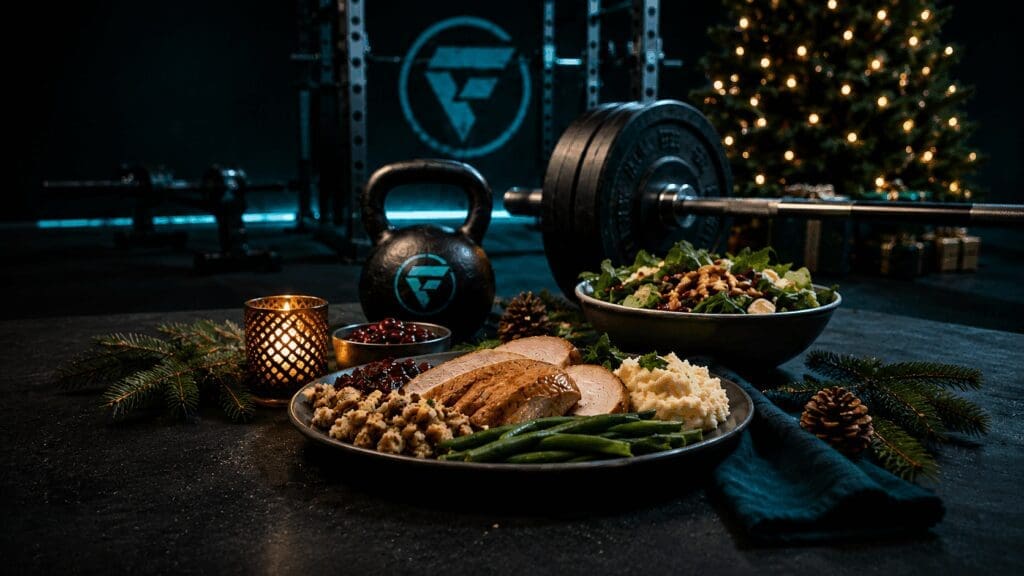
You do not need to bring a food scale to Christmas dinner. A simple visual structure can create balance while leaving room for traditional foods.
The CDC’s current holiday guidance similarly encourages people to make fruits, vegetables, and protein prominent while keeping smaller portions of foods higher in calories, sodium, saturated fat, or added sugars.
Protein can also help anchor a meal, particularly for people who strength train, are trying to preserve muscle during weight loss, or simply find higher-protein meals more satisfying. If you want a deeper explanation, read Forge’s guide to how much protein you actually need.
Fiber-rich foods such as vegetables, fruit, beans, whole grains, nuts, and seeds also contribute fullness and overall diet quality. For more detail, see Fiber and Gut Health: What the Fiber Trend Gets Right.
Choose Your Favorite Holiday Foods—On Purpose
This is one idea from the original 2016 article that still holds up very well.
There is a difference between eating your grandmother’s pie because you look forward to it every year and eating three handfuls of generic candy because a bowl happened to be sitting next to you. Both foods can fit, but one is a deliberate choice and the other is often environmental autopilot.
Ask a better question than “Is this food good or bad?”
Ask: Do I actually want this? If the answer is yes, have it and enjoy it. If the answer is “not really, but it is here,” skipping it is not deprivation. It is simply choosing where you want to spend your appetite.
You can apply the same principle to buffets. Scan the options before loading your plate. Pick the foods that are distinctive, meaningful, or especially enjoyable. You do not receive extra holiday points for sampling every casserole on the table.
Do You Need to Count Calories During the Holidays?
No. Calorie tracking is a tool, not a requirement.
The original version of this article recommended setting a personal calorie limit before each event. That can still be useful for someone who already tracks intake comfortably and wants objective guardrails. But it is not necessary for everyone, and a rigid target can become counterproductive if it turns a celebration into an accounting exercise.
| Approach | When It Can Help | Watch For |
|---|---|---|
| No tracking | You have a stable routine and can use portions, hunger, and meal structure effectively. | Unplanned grazing and liquid calories can be easy to overlook. |
| Loose awareness | You want to keep portions reasonable without logging every ingredient. | Do not turn estimates into false precision. |
| Full tracking | You already track regularly and find the data useful rather than stressful. | Holiday recipes and restaurant portions can be difficult to estimate accurately. |
If you want a baseline estimate for maintenance calories, protein, or a realistic weight-management target, the ForgeScore™ Fitness & Nutrition Calculator can provide a starting point. Treat any calculator as an estimate that needs real-world adjustment.
Alcohol Deserves Its Own Holiday Strategy
The 2016 article was right to call out alcohol, but the explanation needed updating.
Alcoholic drinks add energy, serving sizes are easy to underestimate, and cocktails can contain more than one standard drink. The National Institute on Alcohol Abuse and Alcoholism defines one U.S. standard drink as about 14 grams of pure alcohol—roughly 12 ounces of 5% beer, 5 ounces of 12% wine, or 1.5 ounces of 40% spirits.
Current NIAAA guidance is also straightforward: for overall health, less alcohol is better. If you choose to drink, deciding in advance what and how much you want is more useful than relying on judgment after several pours.
Know the Pour
A large wine glass, strong craft beer, or mixed drink may contain more alcohol than one standard serving.
Alternate
Water, sparkling water, or another non-alcoholic drink between alcoholic beverages can slow the pace and support hydration.
Do Not “Budget” Food Away
Skipping meals so you can drink more can leave you underfed and may make both drinking and eating decisions harder to regulate.
Keep Moving—but Do Not Exercise to “Earn” Holiday Food
Physical activity belongs in the holiday plan because it supports health, fitness, mood, sleep, and routine—not because you need to pay for dessert with burpees.
The CDC specifically encourages maintaining movement during the holidays, even when the schedule changes. That might mean a shorter workout, a family walk, walking while shopping, or adjusting training days around travel.
If your normal program is four workouts per week and the holiday week only allows two good sessions, do the two. A modified week is still a training week.
Protect the habit before chasing the calorie burn
The bigger long-term win is remaining someone who trains and moves during busy seasons. Fitness should make the holidays easier to navigate—not become punishment for participating in them.
Holiday Parties, Travel, and Busy Schedules: Control What You Can
Holiday eating gets harder when normal routines disappear. Travel delays meals. Work parties replace dinner. Family gatherings happen back-to-back. The answer is not perfect control; it is creating a few reliable anchors.
Useful holiday anchors
If you want the broader exercise-and-routine version of this conversation, see Forge’s Top Fitness and Nutrition Tips for the Holiday Season.
What Should You Do the Day After a Big Holiday Meal?
Return to normal.
You do not need to skip breakfast, slash carbohydrates, run ten miles, “detox,” or wait until Monday. Drink normally, eat according to your usual structure and hunger, include protein and produce, and resume your planned activity.
The restrict-overeat cycle often becomes more disruptive than the celebration meal itself. If you overate, acknowledge it and move forward. The fastest way back to your routine is to actually resume it.
A Practical Example: Holiday Dinner at 6:00 PM
This is an example of structure, not a prescription or meal plan.
This approach keeps the holiday meal special without turning the entire day into either a fast or an all-day buffet.
Common Holiday Eating Mistakes
The Bigger Goal: A Nutrition Approach That Survives Real Life
The original version of this article ended with a call for lifelong wellness. That principle still belongs here, but the framing matters.
A sustainable nutrition plan should work during ordinary workweeks and birthdays, vacations, holidays, restaurant meals, travel, stressful seasons, and changes in schedule. If the plan only works when life is perfectly controlled, it is not yet a durable plan.
Forge’s approach is fundamentals first: enough structure to support your goals, enough flexibility to live your life, and enough self-awareness to know when “flexibility” has quietly become abandoning the plan.
For a broader discussion of this idea, read Making Healthy Eating a Lifestyle: Embracing the Joy of Food. If added sugar is one area you want to examine more deliberately after the holidays, the 21-Day No Added Sugar Challenge is designed as an awareness exercise—not a detox.
Frequently Asked Questions About Healthy Holiday Eating
How can I eat healthy during the holidays without dieting?
Should I skip meals before a holiday dinner?
How much weight does the average person gain over the holidays?
Is it okay to have dessert during the holidays?
Should I count calories at holiday meals?
How do I stop overeating at holiday parties?
What should I eat the day after I overeat?
Can I drink alcohol and still manage my weight during the holidays?
Is maintaining my weight through the holidays a good goal?
Build a Nutrition Plan That Works Beyond Perfect Weeks
Articles can explain the principles. A coach helps decide how those principles should fit your calorie needs, food preferences, training, travel, work schedule, family routines, habits, and long-term goals. Forge provides individualized fitness, nutrition, and habit coaching with ongoing adjustments from a real coach.
The free consultation is for people genuinely considering Forge coaching who want to understand how the service works and whether it is a good fit.
Continue Building Your Nutrition Knowledge
Evidence and Further Reading
- Yanovski JA, Yanovski SZ, Sovik KN, Nguyen TT, O'Neil PM, Sebring NG. A Prospective Study of Holiday Weight Gain. New England Journal of Medicine. 2000.
- Schoeller DA. The Effect of Holiday Weight Gain on Body Weight. Physiology & Behavior. 2014.
- Mason F, Farley A, Pallan M, et al. Effectiveness of a Brief Behavioural Intervention to Prevent Weight Gain Over the Christmas Holiday Period: Randomised Controlled Trial. BMJ. 2018.
- Centers for Disease Control and Prevention. How to Have Healthier Holidays in 1-2-3!. Updated 2026.
- Centers for Disease Control and Prevention. Tips for Healthy Eating for a Healthy Weight.
- National Institute on Alcohol Abuse and Alcoholism. Holiday Drinking and Your Health.
Nutrition and medical disclaimer: This article provides general education and is not individualized medical nutrition therapy or medical care. People with diabetes, kidney disease, cardiovascular disease, gastrointestinal conditions, a history of disordered eating, pregnancy-related nutrition needs, medication-related dietary restrictions, or other medical concerns should follow guidance from their qualified health care professionals. Forge coaching does not replace medical treatment.