
Are Meal Plans Worth It? Benefits, Limitations, and How to Use One Without Making Nutrition Rigid
A meal plan can remove a lot of nutritional guesswork—but it should make eating easier, not turn every meal into a compliance test. The most useful plans provide structure around calories, protein, portions, food choices, and meal ideas while leaving enough flexibility for restaurants, travel, substitutions, preferences, and real life.
Forge Verdict
Meal plans are valuable when they are used as frameworks rather than rigid menus. They can reduce decision fatigue, improve food preparation, make calorie and protein targets easier to understand, and give someone concrete examples of what a balanced day can look like. But a meal plan is not inherently personalized simply because a name or calorie number is printed on it—and no single macro ratio or list of foods is ideal for everyone.
Turn Nutrition Advice Into Actual Meals
“Eat more protein and vegetables” becomes much more actionable when you can see portions, combinations, and complete meal examples.
Reduce Daily Food Decisions
A useful plan can simplify grocery shopping, meal preparation, and the question of what to eat next.
Learn the Pattern, Not Just the Menu
The long-term value comes from understanding how to swap foods and adjust the structure when life changes.
What Is a Meal Plan?
A meal plan is a structured example of what someone might eat across a day or week.
Depending on the plan, it may specify:
- meals and snacks
- portion sizes
- estimated calories
- protein, carbohydrate, and fat targets
- recipes
- food substitutions
- grocery items
- dietary preferences such as vegetarian or lactose-free eating
Some plans are highly prescriptive. Others are better understood as sample menus or meal-building frameworks.
The plan is a tool, not the goal.
The real goal is to build an eating pattern that supports health, training, body composition, preferences, and daily life. If a meal plan helps you do that, it is useful. If following the document becomes harder than eating well without it, the plan needs to change.
Meal Plans and Meal Planning Are Not Exactly the Same Thing
| Meal Plan | Meal Planning |
|---|---|
| A predefined example of meals, portions, calories, or macros. | The process of deciding what you will eat, shop for, prepare, and have available. |
| Can reduce uncertainty immediately. | Builds a skill you can use indefinitely. |
| May be written by a professional or selected from a library. | Can be done independently or with a coach. |
| Can become rigid if treated as exact instructions. | Usually adapts more easily to schedules, leftovers, restaurants, and food availability. |
The strongest approach often combines both: use a meal plan to learn the structure, then develop the ability to plan meals without needing the same printed menu forever.
Observational research has found meal planning to be associated with greater food variety, better overall diet quality, and lower odds of obesity, although that type of study cannot prove that meal planning itself caused those outcomes.
8 Real Benefits of Using a Meal Plan
It Makes Nutrition More Concrete
Nutrition advice can become vague very quickly.
“Eat balanced meals” does not tell someone what breakfast looks like. “Get enough protein” does not explain how protein might be distributed through the day.
A meal plan turns abstract advice into examples that can actually be used.
It Can Reduce Decision Fatigue
Food decisions happen repeatedly every day. If every meal starts with opening the refrigerator and improvising, convenience often wins.
A plan reduces the number of decisions that need to be made in the moment.
It Can Make Grocery Shopping Easier
Once meals are loosely established, the grocery list becomes easier to build.
That can reduce last-minute purchases, duplicate ingredients, and food that is bought without a clear purpose.
It Can Help Manage Calories and Portions
Someone pursuing fat loss, weight maintenance, or weight gain may benefit from seeing what an appropriate calorie level looks like in actual food.
That does not mean every calorie must be tracked forever. A plan can teach portions well enough that someone later uses less numerical tracking.
It Can Make Protein Targets Easier to Reach
Protein goals are easier to understand when the target is distributed across meals rather than treated as one daily number.
A plan can show how breakfast, lunch, dinner, and optional snacks contribute to the daily total.
It Can Support Training and Recovery
Meal structure can help place enough energy, protein, carbohydrate, and fluid around training so that nutrition supports rather than competes with the exercise program.
The exact needs vary by body size, goal, training volume, sport, and individual tolerance.
It Can Reveal Where the Diet Is Missing Something
Looking at an entire day can make patterns obvious:
- very little protein until dinner
- almost no fruit or vegetables
- too little total food for training demands
- large amounts of calories coming from beverages
- long gaps followed by uncontrolled evening eating
It Gives You a Starting Point When You Do Not Know Where to Begin
This may be the biggest value for beginners.
A well-built plan answers the immediate question—“What could I actually eat?”—while coaching or education teaches how to modify it over time.
Where Meal Plans Can Go Wrong
A perfect meal plan does not exist.
Schedules change. Restaurants happen. Food availability changes. Appetite changes. Training changes. Travel happens. The better skill is learning how to preserve the nutritional structure when the exact menu changes.
What Actually Makes a Meal Plan Personalized?
A personalized plan is not simply a generic PDF with your calorie number selected.
Useful personalization may account for:
- estimated energy needs
- body-composition goal
- training volume and activity level
- protein needs
- food preferences
- vegetarian, vegan, pescetarian, or other eating patterns
- food allergies or intolerances
- work schedule
- travel
- meal frequency preferences
- cooking ability and available time
- budget
- feedback from actual progress
Even then, “personalized” does not automatically mean superior in every context. Randomized nutrition trials have found that some precision or personalized diet approaches do not necessarily produce greater weight loss or cardiometabolic benefits than well-designed general healthy-diet approaches.
That is an important reminder: personalization is useful when it removes a real barrier or better aligns the plan with the goal—not because personalization itself has magical metabolic effects.
Does a Good Meal Plan Need a Specific Macro Ratio?
No single protein/carbohydrate/fat ratio is optimal for everyone.
Forge meal-plan resources have historically used a 40% carbohydrate / 30% protein / 30% fat split as a practical baseline in some plans, but the current materials explicitly describe macro ratios as flexible rather than something clients should obsess over.
The appropriate distribution depends on factors such as:
- total calories
- protein requirements
- strength or endurance training demands
- food preferences
- medical considerations
- satiety
- digestive tolerance
Protein grams usually matter more than protein percentage.
Thirty percent protein means very different amounts on a 1,500-calorie plan and a 3,500-calorie plan. For training and body-composition goals, protein is often more useful when prescribed relative to body size and goal rather than as a fixed percentage of calories.
For a deeper breakdown, see Proteinmaxxing: What the High-Protein Trend Gets Right—and Where It Goes Too Far.
Are Meal Plans Useful for Fat Loss?
They can be very useful because fat loss requires an energy deficit over time, and a meal plan can make that deficit easier to visualize and execute.
A fat-loss meal plan should generally help someone:
- eat an appropriate amount of total energy
- consume enough protein to support lean-mass retention
- include fiber-rich foods and sufficient produce
- manage portions without unnecessary restriction
- build meals that are satisfying enough to repeat
Controlled trials have shown that structured prepared-meal approaches can improve weight-loss outcomes in some settings. Digital meal-planning interventions have also shown promise for weight loss and long-term weight management.
But the plan only works if the calorie target is appropriate and the eating pattern is sustainable.
Choosing the lowest-calorie plan is not automatically better.
An unnecessarily aggressive deficit can increase hunger, reduce training performance, make adequate nutrition harder, and reduce adherence. Start with an appropriate target and adjust from actual results.
Are Meal Plans Useful for Muscle Gain?
Yes—especially for people who struggle to consistently eat enough.
A muscle-gain plan can help organize:
- adequate total energy
- daily protein
- protein distribution
- carbohydrates to support training
- calorie-dense foods when appetite is limited
- pre- and post-training meals
The objective is not to gain scale weight as quickly as possible. It is to support progressive resistance training while controlling the rate of weight gain.
See How to Eat to Build Muscle Mass for our complete muscle-gain nutrition guide.
What About Meal Plans for Exercise and Sports Performance?
Athletes and highly active people may benefit from more deliberate meal structure because training changes energy and carbohydrate needs.
Performance nutrition may need to account for:
- training duration and intensity
- carbohydrate availability
- pre-training tolerance
- post-training recovery
- hydration and electrolytes
- competition schedules
- multiple daily sessions
A generic “healthy eating” plan may still be nutritionally sound while providing too little fuel for an athlete’s workload.
This is where the nutrition plan needs to align with the actual training plan rather than being created in isolation.
Can Meal Plans Work With Dietary Preferences and Restrictions?
Yes, but it is important to distinguish preference, intolerance, allergy, and medical restriction.
Meal-plan frameworks can be adapted for patterns such as:
- balanced omnivorous eating
- vegetarian eating
- vegan eating
- pescetarian eating
- lactose-free eating
- gluten-free eating
But eliminating a food category should have a reason.
For example, someone with celiac disease requires strict gluten avoidance as medical treatment. That is different from choosing a gluten-free pattern because it feels easier to follow.
Food allergies and medical intolerances also require more care than simply swapping one recipe.
A Fitness Meal Plan Is Not Medical Nutrition Therapy
This distinction matters.
General meal-planning resources can support healthy adults pursuing fitness, body-composition, and general nutrition goals. They should not be presented as medical treatment for:
- diabetes
- kidney disease
- heart disease
- eating disorders
- celiac disease
- significant gastrointestinal disease
- complex food allergies
- other conditions requiring medical nutrition therapy
Those circumstances may require an appropriately qualified registered dietitian and coordination with the person’s physician or other healthcare professionals.
“Personalized” does not expand scope of practice.
A coach can help personalize general nutrition behaviors, calorie targets, meal structure, food choices, and fitness-supportive habits. Medical diagnosis and medical nutrition therapy belong with the appropriate licensed healthcare professionals.
How to Choose a Meal Plan That Is Actually Useful
Start With an Appropriate Calorie Level
Use an estimate based on body size, activity, and goal, then adjust from actual progress instead of assuming the estimate is exact.
Make Sure Protein Is Appropriate
The plan should provide enough protein for your body size, training, age, and goal rather than simply following a universal percentage.
Choose Foods You Will Actually Eat
A nutritionally perfect menu full of foods you dislike is not a sustainable plan.
Match the Cooking Demands to Your Life
A plan for a busy professional may need batch cooking, leftovers, fast breakfasts, and restaurant strategies rather than several fresh recipes every day.
Look for Substitution Flexibility
You should be able to replace chicken with another protein, rice with another carbohydrate, or one vegetable with another without believing the plan has been ruined.
Evaluate Results
Body weight, performance, hunger, energy, digestion, and adherence provide information about whether the plan should remain the same or be adjusted.
How to Turn a Meal Plan Into a Flexible Eating Framework
Instead of memorizing exact meals, identify the structure underneath them.
| Meal-Plan Item | Flexible Pattern | Possible Swaps |
|---|---|---|
| Greek yogurt + berries + oats | Protein + fruit + high-fiber carbohydrate | Cottage cheese + fruit + whole-grain toast; eggs + fruit + oats. |
| Chicken + rice + broccoli | Lean protein + starch + vegetables | Tofu + potatoes + green beans; fish + quinoa + salad. |
| Apple + Greek yogurt | Fruit + protein snack | Berries + cottage cheese; banana + protein shake. |
| Salmon + sweet potato + vegetables | Protein + carbohydrate + produce + dietary fat | Lean beef + rice + vegetables; tempeh + noodles + stir-fry vegetables. |
This is how a document becomes a skill.
You learn what the meals are doing nutritionally, then recreate the pattern with foods that fit the situation.
Our guide to meal preparation explains how to make that process easier without preparing a week of identical meals.
How Forge Meal Plans Work
Forge currently provides a library of 24 structured meal plans across six calorie levels and four baseline eating styles:
- Balanced
- Gluten-Free
- Lactose-Free
- Vegetarian
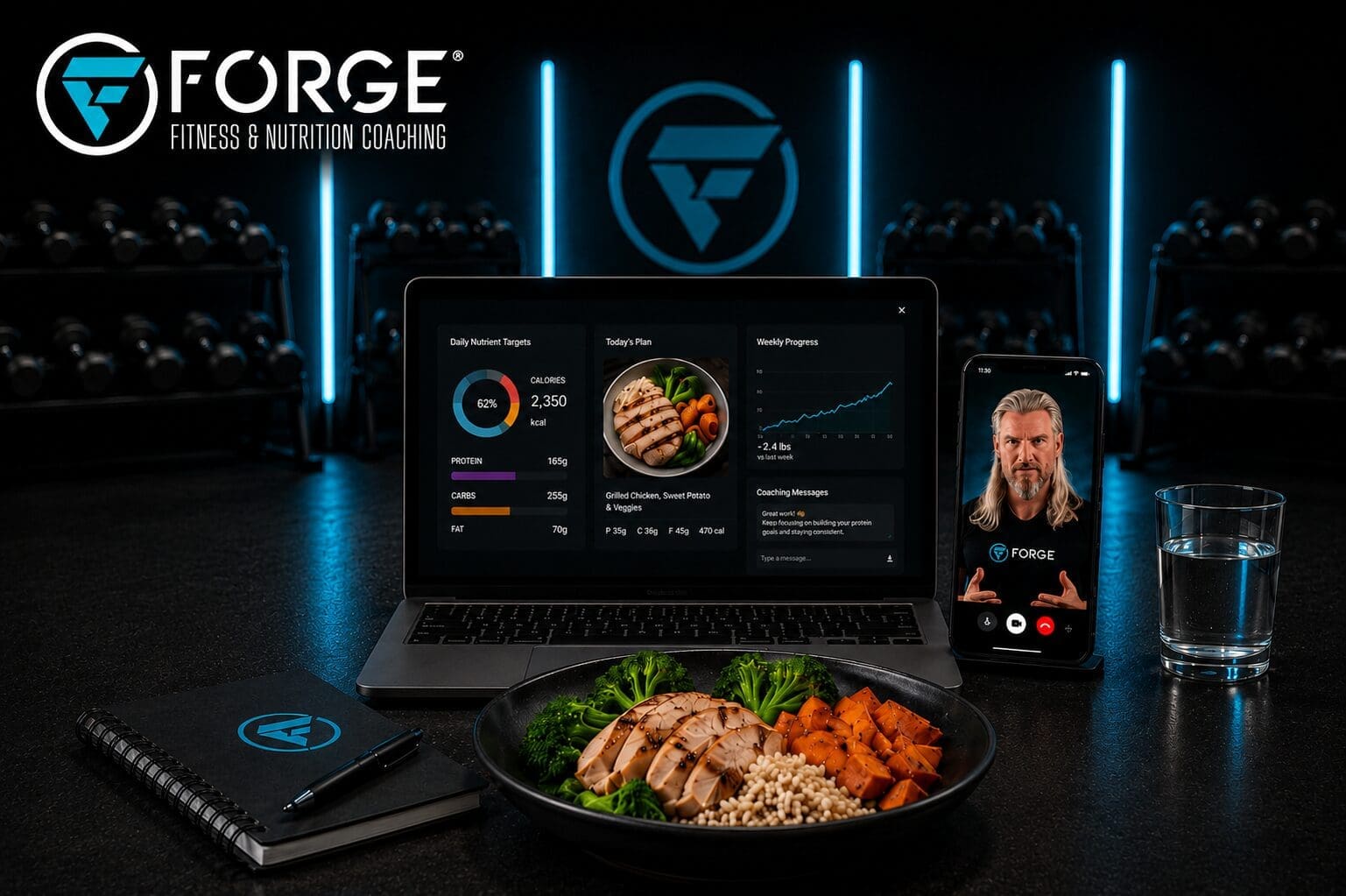
The baseline plans are written by a Registered Dietitian and are designed as starting frameworks rather than rigid rulebooks. Forge coaches can then adjust calorie and macro targets based on the client’s progress and feedback and help with meal substitutions, food logging, grocery planning, and additional food preferences inside the coaching relationship.
That distinction matters.
The PDF gives structure. Coaching provides the adaptation.
Start With the Right Calorie Target
Use the calorie level selected for your actual needs rather than automatically choosing the lowest plan.
Choose the Closest Eating Style
Use the baseline framework that best matches your normal food preferences and restrictions.
Adjust From Real Feedback
Your coach can modify calories, macros, portions, foods, and structure as progress and circumstances change.
You can browse the current Forge meal-plan library or learn more about Forge nutrition coaching.
The Best Meal Plan Eventually Teaches You How to Eat Without One
A meal plan can be extremely useful at the beginning because it provides clarity.
But long-term nutrition cannot depend on always having the correct PDF open.
The deeper skills are:
- recognizing useful portion sizes
- building meals around protein and nutrient-dense foods
- adjusting intake to the goal
- shopping efficiently
- making substitutions
- handling restaurants and travel
- responding to changes in training or body weight
That is why meal plans work best as part of nutrition education rather than as permanent dietary instructions.
Frequently Asked Questions About Meal Plans
Are meal plans worth it?
They can be. Meal plans are especially useful when someone needs structure, meal ideas, portion guidance, or a clearer way to translate calorie and protein targets into food. They become less useful when they are overly rigid or poorly matched to the individual.
Do meal plans help with weight loss?
They can help by creating structure around calorie intake, portions, protein, and food choices. Weight loss still requires a sustained energy deficit over time, so the calorie level and adherence matter more than merely possessing a meal plan.
Can meal plans help me gain muscle?
Yes. A muscle-gain plan can make adequate calories, protein, carbohydrates, and meal timing easier to organize. It should support progressive resistance training and an appropriate rate of weight gain.
Do I need to follow a meal plan exactly?
Usually no. Most healthy adults can treat a meal plan as a framework and substitute foods with similar nutritional roles. Exact adherence may be required in certain clinical situations, but that belongs under appropriate medical nutrition guidance.
Is meal planning healthier than eating spontaneously?
Meal planning has been associated with higher diet quality and greater food variety in observational research, but that does not prove planning itself causes better health. Planning is primarily useful because it can make desirable food choices easier to execute consistently.
What should a good meal plan include?
It should provide an appropriate amount of energy, adequate protein, nutrient-dense foods, produce, sufficient dietary fat, appropriate carbohydrate for activity, and enough flexibility to fit preferences and daily life.
Should meal plans have exact macros?
They can, but exact macros are not required for everyone. Macro targets are estimates and should be adjusted when necessary. Protein is often more useful as a gram target, while carbohydrate and fat can be more flexible depending on training and preferences.
Is 40% carbs, 30% protein, and 30% fat the best macro split?
No universal ratio is best for everyone. Forge has used 40/30/30 as a baseline in some meal-plan resources, but current materials explicitly describe macro ratios as flexible. Individual protein needs, calories, training, food preferences, and medical considerations matter.
How many meals should I eat each day?
There is no mandatory meal frequency for healthy adults. Two, three, four, or more eating occasions can work depending on appetite, schedule, calorie needs, protein distribution, training, and preference.
Should I choose the lowest-calorie meal plan to lose weight faster?
No. Choose an appropriate calorie target based on your estimated needs and goal. An unnecessarily aggressive deficit may make hunger, recovery, nutrient intake, and long-term adherence more difficult.
Can a meal plan be vegetarian?
Yes. A well-planned vegetarian diet can support general health, fat loss, muscle gain, and athletic goals. Protein, iron, vitamin B12, calcium, omega-3 fats, and other nutrients may deserve additional attention depending on the exact eating pattern.
Can I use a gluten-free meal plan if I do not have celiac disease?
You can choose a gluten-free eating pattern if you prefer it, but gluten avoidance is not automatically healthier for people without celiac disease, wheat allergy, or another clinically relevant reason.
Are meal plans from a Registered Dietitian better?
Registered Dietitians have specialized education and training in nutrition and are the appropriate professionals for medical nutrition therapy. For general meal-plan resources, professional authorship can improve quality, but the plan still needs to fit the person’s calories, preferences, goals, and actual circumstances.
How often should a meal plan be changed?
There is no fixed interval. Adjust the plan when body-weight trends, training demands, hunger, food preferences, schedule, medical needs, or adherence indicate that the current structure is no longer appropriate.
Can I eat at restaurants while following a meal plan?
Yes. A flexible approach teaches how to approximate the same meal structure at restaurants rather than requiring every meal to come from a printed menu.
Do I need to weigh all my food?
No. Food weighing can be useful temporarily for learning portions or improving calorie accuracy, but many people can use household measures, portions, visual guides, or structured meal patterns instead.
What is the difference between a meal plan and nutrition coaching?
A meal plan provides a structured food framework. Nutrition coaching adds education, feedback, adjustments, problem-solving, substitutions, accountability, and changes based on how the plan is working in real life.
Use the Meal Plan as a Starting Point. Build the Skills From There.
Forge combines Registered Dietitian-written meal-plan frameworks with personalized nutrition coaching, fitness programming, habit support, progress tracking, and ongoing adjustments. If you are considering coaching and want nutrition built around your training, schedule, preferences, and goals, start with a free consultation.
Evidence & Further Reading
- Ducrot P, et al. Meal Planning Is Associated With Food Variety, Diet Quality and Body Weight Status in a Large Sample of French Adults. International Journal of Behavioral Nutrition and Physical Activity. 2017.
- Metz JA, et al. A Randomized Trial of Improved Weight Loss With a Prepared Meal Plan in Overweight and Obese Patients: Impact on Cardiovascular Risk Reduction. Archives of Internal Medicine. 2000.
- Hu EA, et al. Weight Reduction Through a Digital Nutrition and Food Purchasing Platform Among Users With Obesity. 2020.
- Hu EA, et al. Sustaining Weight Loss Among Adults With Obesity Using a Digital Meal Planning and Food Purchasing Platform for 12, 24, and 36 Months. 2021.
- Aldubayan MA, et al. A Randomized Intervention Comparing Personalized Dietary Advice With a General Healthy Diet. 2022.
- Popp CJ, et al. Effect of a Personalized Diet to Reduce Postprandial Glycemic Response on Weight Loss in Adults With Abnormal Glucose Metabolism. 2022.
- U.S. Department of Health and Human Services and U.S. Department of Agriculture. Dietary Guidelines for Americans, 2025–2030.
- American College of Sports Medicine. Ten Things You Need to Know About Sports Nutrition.
This article and Forge meal-plan resources provide general nutrition education and meal-planning guidance. They are not medical nutrition therapy, diagnosis, treatment, or a substitute for individualized care from a qualified healthcare professional. Nutrition needs can change substantially with diabetes, kidney disease, cardiovascular disease, gastrointestinal disease, pregnancy, eating-disorder history, food allergies, celiac disease, medication use, and other medical circumstances.