
Healthy Body Fat Percentage Guide: What 5% to 40% Really Means for Men and Women
Body-fat percentage is useful because it tells us something the scale cannot: how much of your body weight is fat rather than lean tissue. The problem is that the internet has turned that useful measurement into a beauty contest.
Charts routinely imply that 10% is “ideal” for a man, 20% is “ideal” for a woman, and anything higher represents failure. Others make the opposite mistake and treat body-fat percentage as irrelevant because no single number defines health. Both positions miss the useful middle.
A reasonable body-fat target depends on sex, age, muscle mass, fat distribution, health history, athletic goals, and what someone can maintain without living in a permanent diet. This guide walks from roughly 5% to 40% body fat and explains what each range generally means, what it tends to require, and when getting leaner is likely to improve health versus simply make someone smaller.
Body-fat management should improve your health and your life, not become your life. Reducing excess adiposity, especially abdominal and visceral fat, can meaningfully improve cardiometabolic risk. But there is no health prize for forcing body fat to the lowest number you can tolerate. If maintaining a percentage requires chronic hunger, loss of menstrual function, falling testosterone, poor sleep, food obsession, declining performance, or social isolation, the number has stopped being a useful health target.
About 8–20%
A classic health-linked reference range derived from BMI and body-composition data, not a universal prescription.
About 21–33%
Women normally carry more essential and reproductive fat, so the same percentage cannot be interpreted the same way across sexes.
Use a Range, Not a Decimal
Measurement error alone can be several percentage points. Trends, waist size, strength, labs, and function matter too.
There Is No Single “Perfect” Body-Fat Percentage
One of the most widely cited scientific attempts to define healthy body-fat ranges came from Gallagher and colleagues, who linked measured body composition with established healthy BMI ranges. For adults ages 20–39, their reference ranges were approximately 8–20% for men and 21–33% for women. The ranges moved somewhat higher with age: roughly 11–22% for men and 23–34% for women ages 40–59, and about 13–25% for men and 24–36% for women ages 60–79.
Those numbers are useful anchors, not biological cliffs. A 19.9% reading does not make a man healthy while 20.1% makes him unhealthy. The same is true for a woman at 32.9% versus 33.1%.
Health risk also depends heavily on where fat is stored. Abdominal and visceral adiposity are more strongly linked with cardiometabolic risk than fat stored around the hips and legs. That is why waist circumference can add important information even when body weight or body-fat percentage looks acceptable.
Body-fat percentage is one useful measurement, not a diagnosis.
I would rather see a client at 18% body fat who is strong, active, sleeping well, eating normally, and maintaining the result comfortably than someone at 10% who is exhausted, food-focused, losing performance, and white-knuckling every weekend.
Before You Chase a Number, Know How Inexact the Number Is
Body-fat percentage is estimated, not directly observed. DXA is extremely useful for tracking fat mass, lean mass, and regional changes, but even DXA can shift with hydration and other technical factors. Bioelectrical impedance devices are convenient and useful for repeated trends, but individual estimates can differ from DXA by several percentage points.
In a study of active-duty Marines, an InBody 770 showed a mean absolute error of about 3.9 percentage points for body-fat percentage compared with DXA. That does not make BIA useless. It means arguing over whether you are 14.2% or 15.8% is usually misplaced precision.
Use the same device, under similar conditions, and pay more attention to the trend. Our InBody and DEXA guide explains how to interpret repeated body-composition measurements without turning every scan into a verdict.
Visual estimates are even rougher.
Two people at the same measured percentage can look very different because of muscle mass, fat distribution, bone structure, skin thickness, age, lighting, and genetics. The illustrations below are teaching tools, not diagnostic images.
What Different Body-Fat Ranges Can Look Like
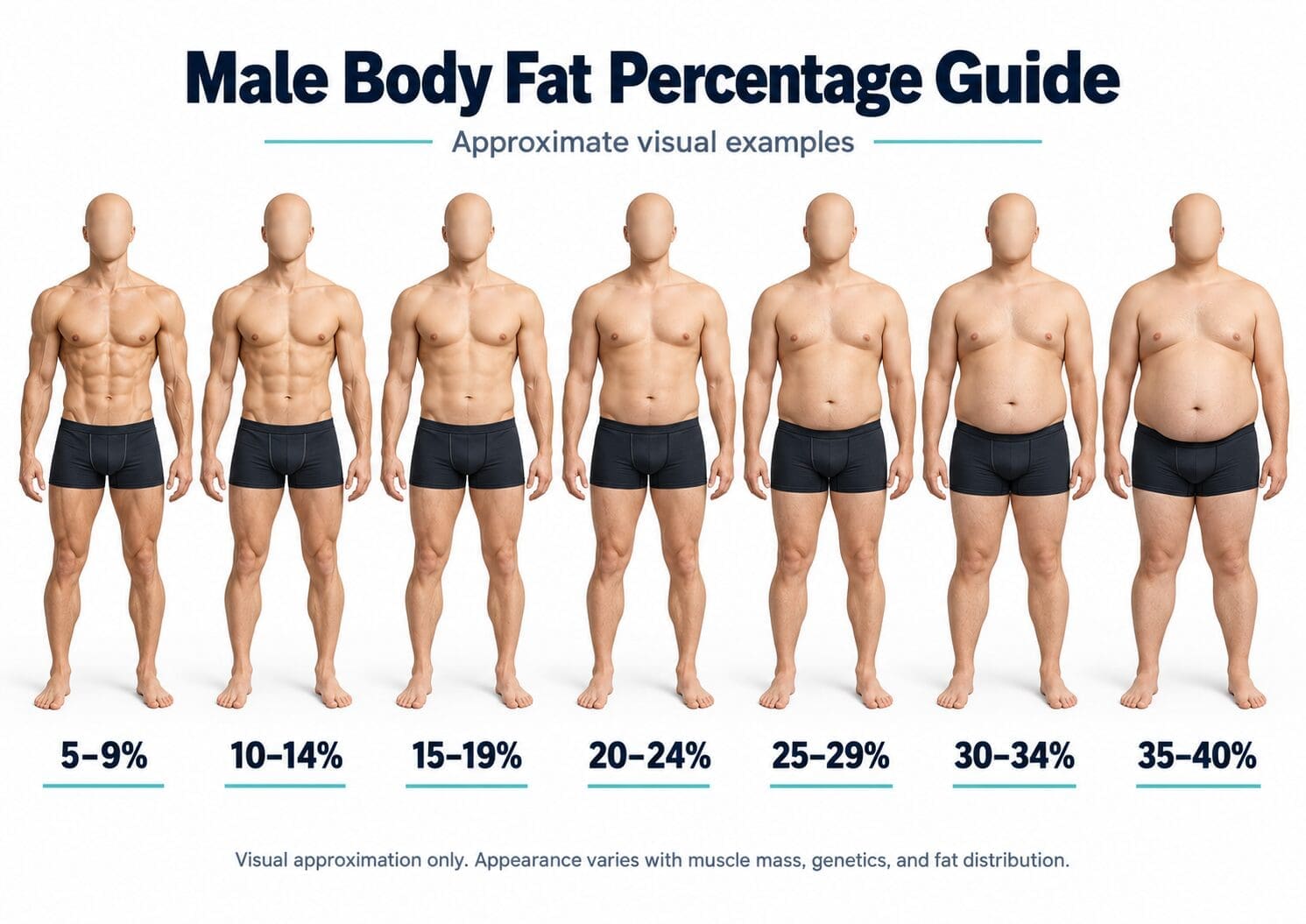
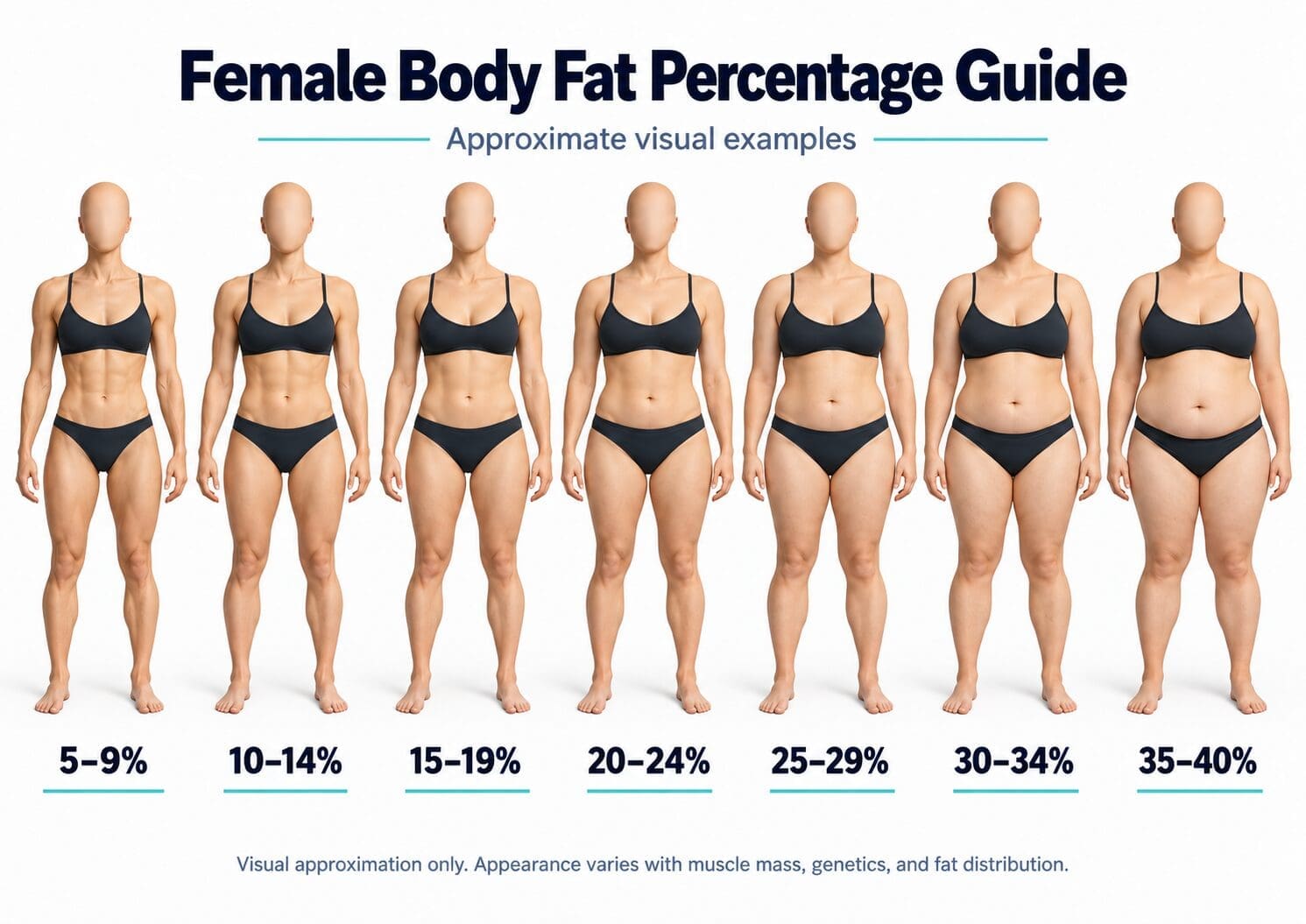
The shared 5–40% scale makes comparison easy, but it should not imply that the same range has the same physiological meaning for men and women. A woman at 20% body fat is quite lean. A man at 20% is generally in a much more moderate range.
5–9% Body Fat: Extreme Leanness
This is bodybuilding-stage or photo-shoot-level leanness for many men. Abdominal separation, vascularity, and very little subcutaneous fat are typical. Some genetically lean men may tolerate the upper end better, but maintaining the lower end often requires substantial dietary restraint and can coincide with low energy availability, hormonal disruption, poor sleep, irritability, and declining training performance.
For most women, 5–9% is below a reasonable physiological target and approaches or falls below essential-fat requirements. It should not be presented as a lifestyle goal. The health concerns around severe energy deficiency include menstrual dysfunction, reproductive suppression, impaired bone health, altered endocrine function, and reduced performance.
What it generally takes: for men, typically highly controlled food intake, frequent monitoring, years of muscle-building beforehand if the goal is a muscular appearance, and often a short-term competitive purpose. For women, this is not a range I would coach toward for general fitness or health.
10–14% Body Fat: Very Lean for Men, Extremely Lean for Women
Visible abs, clear muscular separation, and a lean athletic appearance are common. The upper part of this range can be sustainable for some experienced men, especially those with favorable appetite regulation and long training histories. The lower part becomes progressively more demanding.
This remains extremely lean. Female physique athletes may transiently reach this territory, but it is well below population health-reference ranges. Maintaining it can increase the likelihood of low energy availability and reproductive or bone-health consequences.
What it generally takes: men usually need consistent resistance training, high food-quality standards, portion awareness or calorie tracking, adequate protein, regular activity, and fewer unplanned high-calorie meals. For women, the question should be whether there is a legitimate competitive reason and appropriate medical/sports-nutrition oversight, not how to make the number permanent.
15–19% Body Fat: Lean and Often Sustainable for Men; Athletic-Lean for Women
This is where many trained men can look distinctly lean without needing contest-level behavior. Ab definition varies with muscle development and genetics. For a healthy, resistance-trained man, this can be a very practical long-term range.
This is a lean athletic range and below the classic health-reference range for younger women. Some trained women maintain it comfortably; others develop menstrual changes or signs of low energy availability. Individual response matters more than aesthetics.
What it generally takes: structured resistance training, consistent protein intake, mostly minimally processed foods, reasonably controlled portions, regular movement, and enough cardiovascular work to support health. Most people do not need perfect eating; they do need repeatable habits.
I strongly support getting leaner when a client is carrying more body fat than is helping them. I have watched clients improve blood pressure, glucose control, sleep, movement quality, confidence, conditioning, and day-to-day comfort as their waist and body fat came down. Lower visceral fat in particular matters. Where I draw the line is the idea that if 18% is good, 12% must be better and 8% must be best. Health improves when excess adiposity comes down; it does not improve forever as body fat approaches zero. My goal is to help someone get lean enough to capture the benefits and still have a normal life.
20–24% Body Fat: Moderate for Men, Lean-to-Fit for Women
Muscle shape may still be visible, but abdominal definition is usually limited unless the person carries substantial muscle. Younger men are beginning to move above the classic Gallagher health-reference range, so waist size, blood pressure, lipids, glucose, and activity become increasingly useful context.
This is a lean, fit range for many women and overlaps the lower end of commonly cited healthy ranges. Visible muscular definition is possible without requiring the extreme energy restriction associated with physique competition.
What it generally takes: regular training and decent nutrition can often maintain this territory without detailed tracking. Someone trying to move lower may need more attention to portions and energy intake, but the plan should remain compatible with social meals, travel, and normal life.
25–29% Body Fat: Higher Adiposity for Men, Common and Often Healthy for Women
This is above classic health-linked reference ranges for younger men. Health risk varies enormously depending on waist circumference, visceral fat, fitness, muscle mass, blood pressure, glucose, lipids, smoking, and family history. If abdominal fat is accumulating, moving lower is usually a worthwhile goal.
This sits comfortably inside the classic 21–33% health-linked range for younger adult women. A woman can be strong, metabolically healthy, athletic, and visually fit here. There is no scientific reason to assume she should automatically diet to 20%.
What it generally takes: maintenance may require little deliberate dieting if energy intake and expenditure are naturally balanced. For a man reducing from this range, a modest calorie deficit plus resistance training, walking, and regular cardio can produce visible changes without aggressive restriction. For a woman, whether fat loss is warranted should depend on goals and health context rather than the number alone.
30–34% Body Fat: High for Men, Upper-Healthy to Elevated for Women
At this level, total adiposity and waist circumference are more likely to be clinically relevant. Population research links higher total and central fat with greater risk of type 2 diabetes, hypertension, fatty liver disease, sleep apnea, cardiovascular disease, and other conditions.
The low end can still overlap health-reference ranges depending on age, while the upper end begins moving into elevated-adiposity classifications. Waist circumference and metabolic markers become more informative than appearance alone.
What it generally takes: someone does not need to be lazy or live on fast food to reach this range. Small energy surpluses accumulated over years, declining activity, sleep disruption, medications, pregnancy, aging, stress, genetics, and an energy-dense food environment can all contribute. The encouraging part is that meaningful improvement usually does not require “fitness-model” behavior. Consistent meal structure, resistance training, walking, and cardio can move health markers before the person becomes visibly lean.
35–40% Body Fat: Substantial Adiposity and a Health-Focused Fat-Loss Opportunity
This is well above common body-fat reference ranges. Abdominal and visceral fat are often elevated, although only proper measurement can tell us how an individual stores fat. A health-focused reduction is likely to be beneficial for many men in this range.
The lower part is elevated for many younger women and may still overlap age-adjusted ranges in some older adults, while approximately 40% and above is commonly used in research as a high-adiposity threshold. Again, central fat and medical risk factors matter greatly.
What it generally takes: the first phase should usually be simpler than people expect. Build repeatable meals, reduce obvious excess calories, prioritize protein and high-fiber foods, resistance train two or more days each week, increase daily movement, and gradually build aerobic capacity. At this range, a 5–10% reduction in body weight can improve several risk factors even before a “normal” body-fat percentage is reached.
Why Higher Body Fat Often Requires Less Deliberate Effort Than Getting Very Lean
It is tempting to describe higher body fat as a lack of effort, but physiology and environment are more useful explanations than character judgments.
Human beings live in an environment where highly palatable, calorie-dense food is inexpensive and constantly available while work, transportation, and entertainment often require very little movement. A relatively small average energy surplus sustained over years can gradually increase fat mass. Genetics, sleep, medications, age, appetite, socioeconomic factors, pregnancy, stress, and medical conditions can all modify that trajectory.
By contrast, moving from moderately lean to extremely lean often requires deliberately resisting the body's normal compensatory responses to weight loss: hunger increases, spontaneous movement can fall, energy expenditure adapts, and food becomes more psychologically salient.
That difference is why losing the first substantial amount of excess fat may require fewer restrictions than taking an already lean body into contest condition.
How to Move to a Lower Body-Fat Range Without Sacrificing Muscle
The basic strategy does not change because someone wants to move from 35% to 28% instead of 18% to 14%. What changes is how aggressive the plan needs to be and how much precision is required.
I prefer to adjust food intake from real progress rather than pretending a calorie calculator can predict the perfect target forever. Our ForgeScore™ calorie and protein calculator gives a useful starting estimate, and then weight, waist, performance, hunger, and body-composition trends tell us what needs to change.
If the goal is to preserve muscle while dieting, the combination matters. Diet-only weight loss tends to include some fat-free-mass loss. Resistance training shifts that outcome in a better direction, which is one reason our coaching never treats exercise as merely a way to burn calories.
The Leaner You Get, the More Precision Usually Matters
| Starting Point | Nutrition Structure | Training Expectation | Typical Coaching Priority |
|---|---|---|---|
| 35–40% | Basic meal structure, food quality, portions, drinks, and consistency may create meaningful progress without meticulous tracking. | Build tolerance: walking, 2–3 resistance sessions, progressive cardio. | Health, adherence, mobility, strength, and early wins. |
| 30–34% | A consistent calorie deficit becomes more intentional, but simple habits can still carry much of the plan. | Regular resistance work plus increasing aerobic volume and daily movement. | Waist reduction, strength, metabolic health, sustainable routine. |
| 25–29% | Portion control, protein, meal planning, and some tracking may become useful depending on sex and goal. | Progressive resistance training and routine cardio. | Preserve or build muscle while reducing fat. |
| 20–24% | Men seeking greater leanness often need more consistency; many women may have no health reason to diet lower. | Strength progression remains central; cardio supports fitness and energy expenditure. | Decide whether getting leaner improves the actual goal. |
| 15–19% | Men can often maintain with strong habits; women should monitor energy availability and menstrual health closely. | Maintain performance rather than piling on fatigue. | Sustainability and muscle retention. |
| 10–14% | Typically greater tracking, meal planning, and control, especially toward the lower end. | Enough stimulus to retain muscle without exceeding recovery capacity. | Question whether the benefit justifies the cost. |
| 5–9% | For men, often short-term physique-sport precision. For women, not a general health target. | Performance can become harder to maintain as energy availability falls. | Health monitoring and a planned exit from extreme leanness. |
How Lean Should You Actually Get?
For most people, the best answer is not “as lean as possible.” It is lean enough that excess fat is no longer working against health or performance, while high-quality training, normal eating, sleep, hormones, mood, and social life remain intact.
If someone begins with substantial abdominal obesity, I am strongly in favor of losing fat. The health evidence is not ambiguous: excess adiposity, especially around the waist, is associated with higher risk of type 2 diabetes, hypertension, cardiovascular disease, fatty liver disease, sleep apnea, kidney disease, and other problems. Even modest initial weight loss can improve risk markers.
At the other end, the IOC consensus on Relative Energy Deficiency in Sport makes equally clear that prolonged or severe low energy availability can compromise reproductive function, bone health, immunity, cardiovascular and hematologic health, metabolism, psychological well-being, and performance in both women and men.
That gives us two mistakes to avoid: normalizing excess adiposity when reducing it would improve health, and glamorizing extreme leanness when maintaining it degrades health.
A useful goal has an exit condition.
Do not just ask, “How low can I get?” Ask, “At what range are my health markers good, my waist controlled, my strength high, my food intake normal, and my lifestyle sustainable?” Once those boxes are checked, another two percentage points may add very little.
This is closely aligned with the approach I describe in The 90-Day Habit Transformation: the plan has to function when life is ordinary, not only when motivation and control are unusually high.
Frequently Asked Questions About Body-Fat Percentage
What is a healthy body-fat percentage for men?
For men ages 20–39, a classic health-linked reference range is roughly 8–20%. Gallagher's ranges rise to about 11–22% at ages 40–59 and 13–25% at ages 60–79. These are reference ranges, not individual prescriptions.
What is a healthy body-fat percentage for women?
For women ages 20–39, a classic health-linked reference range is roughly 21–33%, rising to about 23–34% at ages 40–59 and 24–36% at ages 60–79. Athletic women may fall below these ranges, but lower is not automatically healthier.
Is 15% body fat healthy?
For many men, 15% can be lean, healthy, and sustainable. For women, 15% is very lean and below common health-reference ranges, so menstrual function, energy availability, bone health, recovery, and individual context matter.
Is 20% body fat healthy?
For many men, 20% sits near the upper end of younger-adult reference ranges. For women, 20% is quite lean and near or below the lower end of many health-based ranges. Waist size, fitness, labs, and age provide important context.
Is 30% body fat unhealthy?
It depends strongly on sex and age. Thirty percent is high for most men but can fall within a healthy reference range for many adult women. Fat distribution and metabolic health are important additional considerations.
Is 5% body fat safe?
Five percent is extreme for men and not an appropriate general-health target. For women it is below a reasonable physiological target. Severe leanness maintained through chronic low energy availability can create hormonal, reproductive, bone, metabolic, and performance problems.
What is the most accurate way to measure body fat?
No method is perfect. DXA provides useful estimates of fat mass, lean mass, and regional composition. BIA can be practical for repeated trends. Whatever method you use, standardize conditions and avoid treating a single decimal as exact truth.
How quickly should I lower body fat?
The appropriate rate depends on starting adiposity, training experience, medical context, and how lean the person already is. Higher-fat clients can often tolerate a larger deficit than already-lean clients. The plan should preserve strength, protein intake, recovery, and normal function rather than chase the fastest possible scale loss.
Do I need cardio to lower body fat?
No specific form of cardio is mandatory for fat loss, but aerobic exercise improves cardiovascular fitness and can help increase energy expenditure. I generally prefer combining resistance training, aerobic work, and daily movement rather than trying to diet harder.
Do I need to count calories?
Not always. Higher starting body-fat levels may respond well to simple food-structure changes. As someone becomes leaner, energy intake often needs to be managed more precisely. Tracking is a tool, not a requirement or a measure of discipline.
Related Forge Resources
Get Leaner Without Making Leanness Your Entire Life.
Forge combines resistance training, cardio, nutrition, body-composition tracking, recovery, and habit coaching around your actual starting point. The goal is not the lowest body-fat number possible. It is a stronger, healthier body you can realistically maintain.
Evidence and Supporting Documentation
- Gallagher D, et al. Healthy percentage body fat ranges: an approach for developing guidelines based on body mass index. American Journal of Clinical Nutrition. 2000.
- National Institute of Diabetes and Digestive and Kidney Diseases. Am I at a Healthy Weight? BMI, waist size, and health risk.
- National Institute of Diabetes and Digestive and Kidney Diseases. Health Risks of Overweight and Obesity.
- Ross R, et al. Waist circumference as a vital sign in clinical practice: consensus statement from the IAS and ICCR Working Group on Visceral Obesity. Nature Reviews Endocrinology. 2020.
- Jayedi A, et al. Central fatness and risk of all-cause mortality: systematic review and dose-response meta-analysis of 72 prospective cohort studies. BMJ. 2020.
- Zong G, et al. Total and regional adiposity measured by DXA and mortality in NHANES 1999–2006. Obesity. 2016.
- Heitmann BL, et al. Joint association between body fat and its distribution with all-cause mortality: NHANES cohort analysis. 2018.
- High precision but systematic offset in standing bioelectrical impedance analysis compared with DXA. BMJ Nutrition, Prevention & Health. 2023.
- Pietrobelli A, et al. DXA fat-estimation errors due to variation in soft-tissue hydration. American Journal of Physiology. 1998.
- Binmahfoz A, et al. Effect of resistance exercise on body composition, muscle strength and cardiometabolic health during dietary weight loss: systematic review and meta-analysis. 2025.
- Enhanced protein intake on maintaining muscle mass, strength, and physical function in adults with overweight/obesity: systematic review and meta-analysis. 2024.
- Mountjoy M, et al. 2023 International Olympic Committee consensus statement on Relative Energy Deficiency in Sport. British Journal of Sports Medicine.
- Ihalainen JK, et al. Endocrine consequences of problematic low energy availability in female athletes. Sports Medicine. 2024.
- Fagerberg P. Negative consequences of low energy availability in natural male bodybuilding: a review. International Journal of Sport Nutrition and Exercise Metabolism. 2018.
- U.S. Department of Health and Human Services. Physical Activity Guidelines for Americans: Questions and Answers.
Health and body-composition disclaimer: Body-fat percentage is an estimate and should not be used by itself to diagnose health status, obesity, an eating disorder, or Relative Energy Deficiency in Sport. Appropriate body composition depends on sex, age, health history, fat distribution, muscle mass, and individual physiology. People with menstrual disruption, significant fatigue, recurrent injury, disordered eating, rapid unexplained weight change, or other health concerns should seek evaluation from an appropriately qualified healthcare professional.